May 12, 2026
glTF vs GLB: the difference and which you need
GLTF is an open file format for 3D models. You can use it in different programs. You'll also come across it when you download a 3D model from Sketchfab or a similar platform. This article explains what it is, how it relates to GLB and how to convert it.
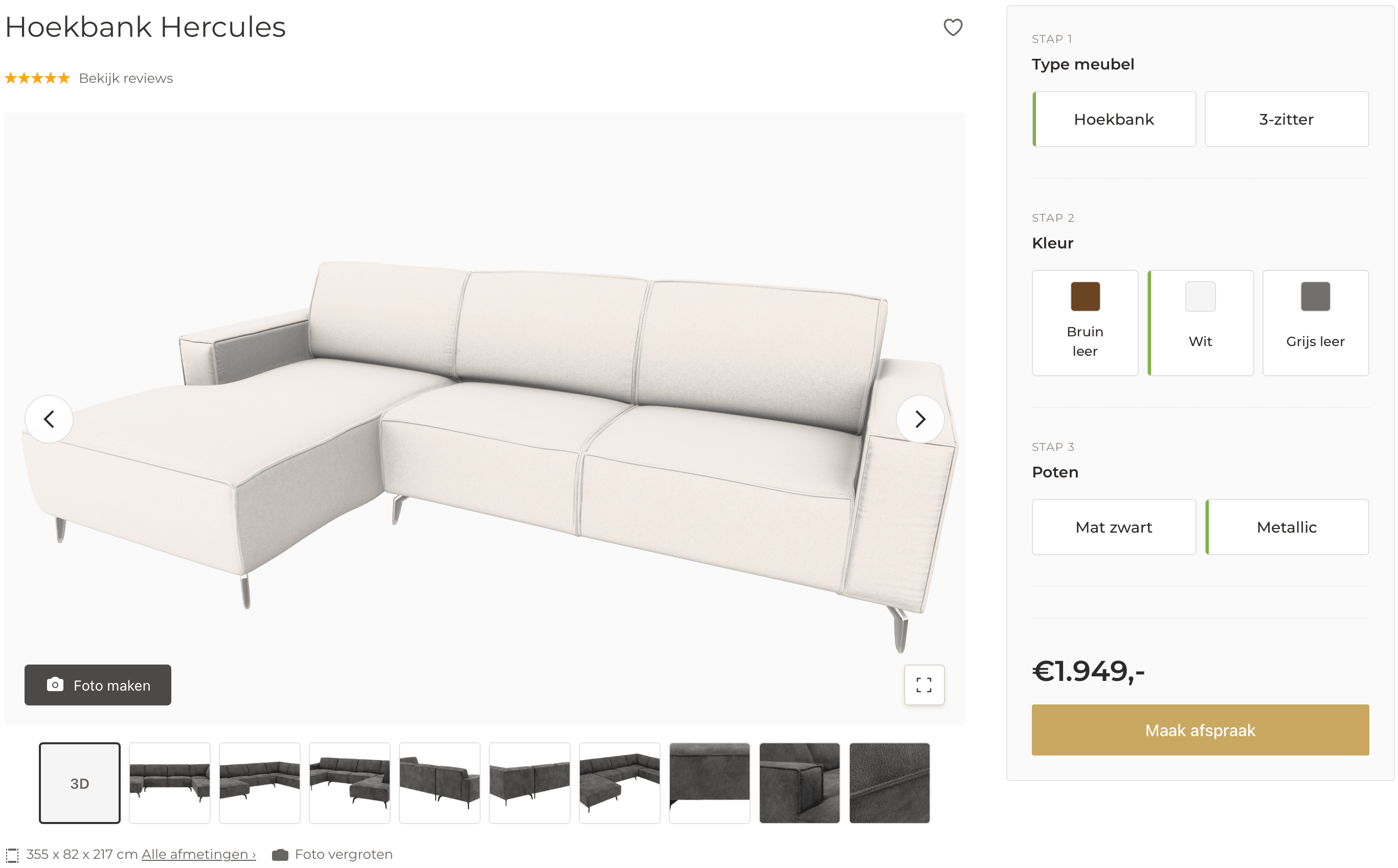
What is the difference between glTF and GLB?
glTF and GLB are the same 3D format in 2 packages. A .gltf file is readable JSON, with the geometry and textures in separate files. A .glb bundles all of that into 1 binary file. For a webshop, a browser or AR you need GLB. glTF is for editing.
| .gltf | .glb | |
|---|---|---|
| Files | A JSON text file plus separate files for geometry (.bin) and textures | 1 binary file with everything inside |
| Readable | Yes, open it in any text editor | No, you need a 3D tool or viewer |
| Delivery | Several files that have to stay together | 1 file, nothing gets lost |
| Best for | Building and editing, version control | Webshops, browsers and AR |
What is the GLTF standard?
GLTF stands for GL Transmission Format. GL is short for Graphics Library, a family of standards for 3D graphics. Behind those standards sits the Khronos Group, an international consortium of technology companies. The same group is responsible for both the GLTF standard and WebGL, the technology browsers use to render 3D.
The GLTF standard sets out what a 3D model must contain. From the shape and the materials to any animations and scene info. All tools share those agreements. That lets you build a model in one tool and show it in another, without losing information.
Version 2.0 of the standard has been stable since 2017. The developers maintain it openly, so anyone can look up the rules or propose improvements. New additions arrive regularly for better quality and smaller files.
GLTF (.gltf) and GLB (.glb): two file variants
The section above was about the GLTF standard. In practice, that standard comes in two file variants, with different extensions and different purposes.
.gltf is split into a text file with the scene info plus separate files for textures and geometry. Because the text file is readable, tools and scripts can inspect and modify its contents. That's why this variant is mainly used while a model is being built and exchanged.
.glb packs everything into a single file. More compact, faster to load and easier to deliver. This is the variant that ends up on a webshop, works in browsers and is suited for AR.
How do you view a GLTF file?
Three routes, depending on what you need.
Online viewers
For a quick look, gltf.report is the simplest choice. Drop your file in and you see the geometry, polycount, texture formats and any validation issues. Babylon.js Sandbox and the Three.js editor offer more control over rendering.
Native viewers
Windows has a built-in 3D Viewer app that opens both .glb and .gltf for a first preview. macOS doesn't offer that natively, so an online viewer like gltf.report is usually the fastest route there. Both options work for a first impression, not for deeper validation.
Inside your own project
To show a 3D model in your own web app you need a viewer. That's software that loads and renders the model in the browser. Developers can build one themselves with open-source libraries, but that takes development time and ongoing maintenance. For publishing to a live website, converting to GLB and hosting through a tool like Virtualdisplay Portal is usually the faster route. More on that further down.
Converting GLTF to other formats
Five conversions you'll run into in practice.
To GLB
The most common conversion. Online through gltf.report with the export button. Via the CLI with gltfpack, a single command with optional Draco or Meshopt compression. In Blender via File, Export, glTF 2.0 with format GLB.
To OBJ
Loses materials and animations. Only useful when you have to work with old software that can't read GLTF. Blender imports GLTF and exports OBJ in two clicks.
To STL
For 3D printing. Loses all texture and material info because STL only knows geometry. Blender handles the conversion. Online is also possible through gltf.report with the mesh export.
To FBX
Works for design software that can't read GLTF. Blender does the conversion. Expect loss of modern material features like PBR extensions.
To USDZ
For Apple AR on iOS, iPad and Vision Pro. Apple's Reality Converter is free on macOS. Online via gltf2usdz.com. The official toolchain requires macOS.
Rule of thumb: convert everything to GLB for web and AR. Other formats only when tooling demands it.
What's in the GLTF specification?
The GLTF 2.0 spec is maintained at github.com/KhronosGroup/glTF. The main parts are asset info, scenes and nodes for hierarchy, mesh and primitives for geometry. Alongside those: materials, animations, skins and textures.
Where the standard really gets powerful is in the extensions. KHR_draco_mesh_compression for geometry compression. KHR_texture_basisu for KTX2 textures. KHR_materials_transmission, _ior, _sheen and more for advanced PBR materials. EXT_meshopt_compression as an alternative to Draco.
Not every viewer supports every extension. Always validate through the official gltf-validator when you get a file from a supplier. A GLTF with unknown extensions can look fine in your viewer and break in the client's.
When GLTF, when GLB?
In practice you work in GLTF and deliver a GLB. That matches what each variant was built for.
Pick GLTF for the phase where tools and people work together on a model. The text file is readable and inspectable, and separate files are easier in version control because you can see what changes per version.
Pick GLB for the final phase. Compact, single file, ready for production and publication on a webshop or in AR.
In almost every 3D pipeline that's the natural order. GLTF while working, GLB at delivery.
Going to the web or AR? Convert to GLB and host on Portal
You have a GLTF and want to show it online, on a product page or in a demo. The first step is converting to GLB. The second step is hosting. For that you need a tool that does three things. Serve the GLB file over a fast CDN. Provide a viewer so visitors install nothing. And work on desktop, mobile and in AR.
Virtualdisplay Portal does exactly that. Convert your GLTF to GLB using gltf.report or gltfpack, upload to Portal and you get an embed code. Your first model is free. For 3D artists and developers who want to demo their work to a client or in a project, that's the fastest route.
Want to know more about GLB as a web format? Read our explainer on the GLB file for webshops. For what happens to that file next, hosting a 3D model in minutes walks through the whole route.
Ready to put your GLTF online?
Convert to GLB and upload to Portal. One line of embed code, your first model is free.